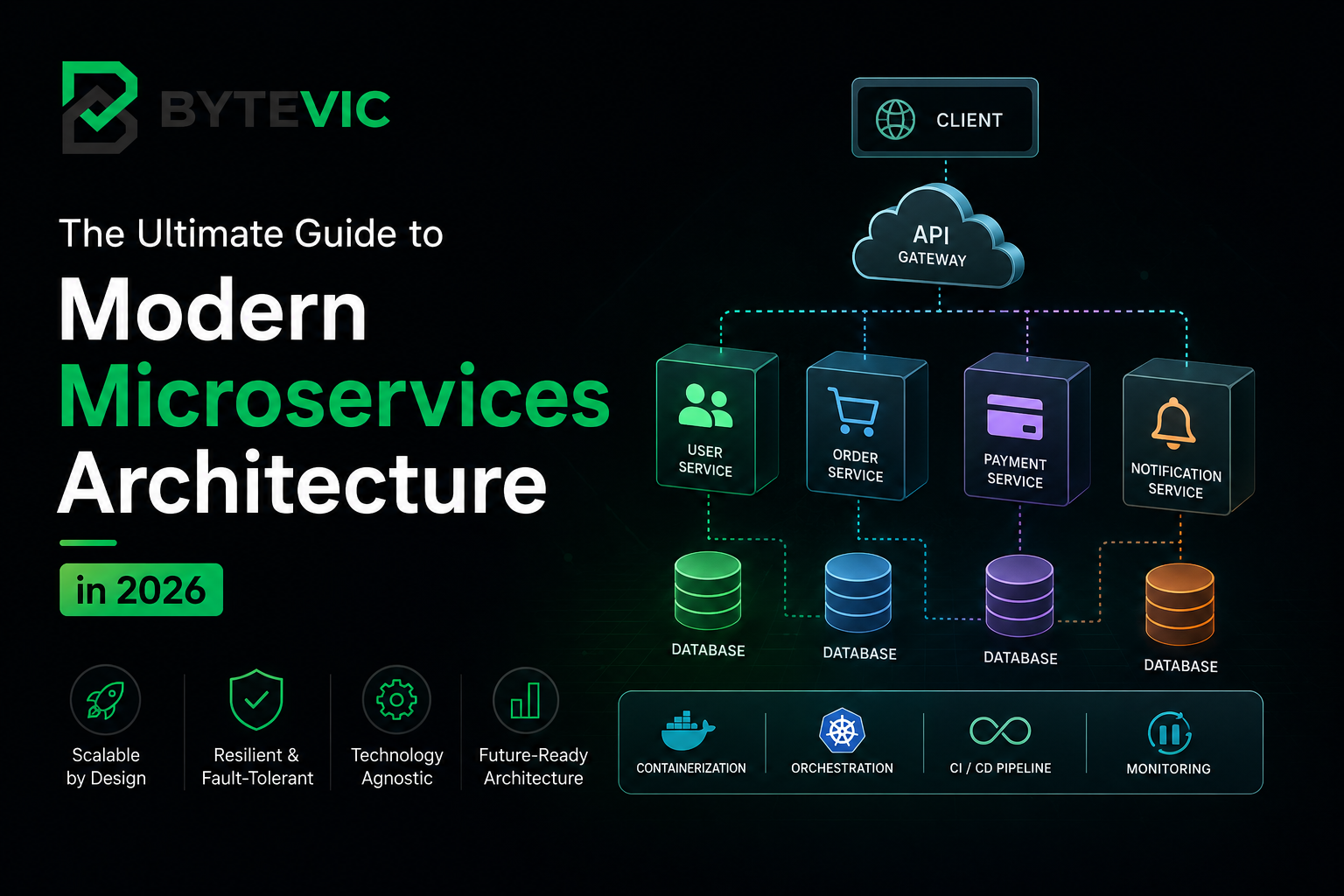
In 2026, the architectural landscape has shifted from traditional monolithic systems to highly distributed, resilient microservices. But as complexity increases, so do the challenges of orchestration, observability, and data integrity. In this guide, the ByteVic Engineering Team shares battle-tested patterns for scaling microservices architecture to handle millions of transactions with low latency.
1. Beyond the Basics: The Evolution of Service Mesh
Service meshes like Istio and Linkerd have become the backbone of modern enterprise infrastructure. However, the industry is moving away from proxy-based sidecar models due to resource overhead and latency concerns. Instead, we are adopting "Sidecar-less" architectures using eBPF (Extended Berkeley Packet Filter) at the kernel level.
Unlike traditional models where every pod requires a dedicated Envoy proxy container (which intercepts and routes traffic at the user space), eBPF works directly within the Linux kernel. This allows routing, network policy enforcement, and telemetry gathering to happen with near-zero latency.
ByteVic Architecture Case Study:
By migrating our enterprise client's Kubernetes cluster from sidecar-based service meshes to eBPF-based systems (like Cilium), we achieved a 22% reduction in overall cluster CPU utilization and dropped tail latency (p99) by 14ms.
2. Event-Driven Architecture and Decoupling
Synchronous HTTP communication creates direct dependencies. If Service A calls Service B, and Service B calls Service C, a failure in Service C cascades all the way back, leading to a complete system outage. Modern architectures build around asynchronous, event-driven backbones using Apache Kafka, RabbitMQ, or NATS JetStream.
When a user places an order, the Order Service publishes an OrderPlaced event and immediately returns a success status. Downstream services (Inventory, Billing, Notifications) consume this event at their own pace. This pattern insulates the user from downstream server slow-downs and maintains high availability.
3. Maintaining Consistency with the Saga Pattern
In a distributed system, a single business transaction can span multiple databases. Since 2-Phase Commit (2PC) protocols are too slow and hold database locks for too long, we use the Saga Pattern for eventual consistency.
A Saga consists of a series of local transactions. If one step fails, the Saga orchestrator triggers compensating transactions in reverse order to roll back the state. For example, if card billing fails, the reserved inventory is automatically released.
// Example Saga Orchestrator logic built by ByteVic
async function processOrderSaga(orderId, paymentDetails) {
  try {
    // Step 1: Reserve Inventory
    await inventoryService.reserveStock(orderId);

    // Step 2: Process Payment
    const payment = await paymentService.chargeCard(orderId, paymentDetails);

    if (!payment.success) {
      throw new Error("Payment declined");
    }

    // Step 3: Dispatch shipment
    await shipmentService.createShipment(orderId);

  } catch (error) {
    // Trigger Compensation actions
    console.error("Saga failed, executing rollbacks...");
    await rollbackInventory(orderId);
    await notifyUserOfFailure(orderId);
  }
}
4. Hybrid Serverless and Containers
In 2026, the debate is no longer Containers vs. Serverless. High-frequency, persistent tasks run on Docker/Kubernetes, while transactional, bursty workloads (e.g., generating PDFs, processing media uploads) are offloaded to Serverless platforms like AWS Lambda or Cloud Run.
This hybrid routing minimizes cloud computing costs while ensuring the system can automatically scale to handle millions of sudden requests.
Conclusion
Transitioning to microservices is an evolutionary step for growing digital enterprises. At ByteVic Systems, we build clean, distributed architectures designed for massive scale. Contact our software architects to review your system topology today.